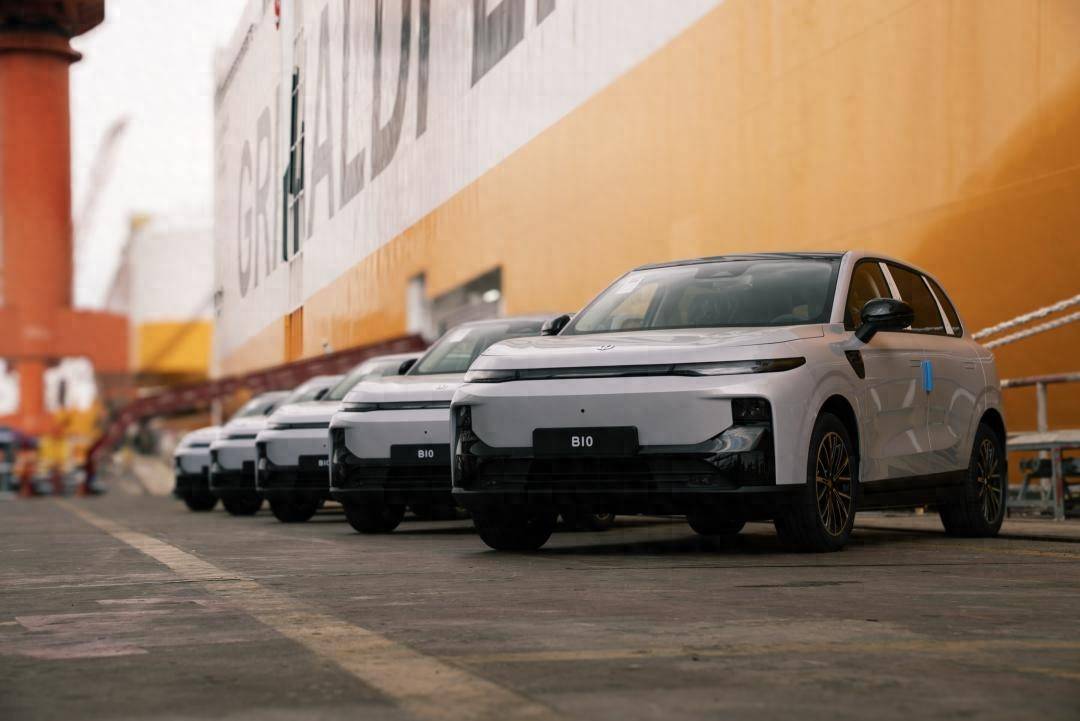
China's NEV overseas expansion has crossed the "0-to-1" phase and now stands at the turning point from "scale to value." In the first five months of 2026, NEV exports reached 1.833 million units, a 1.1-fold year-over-year increase, with their share of total exports exceeding 45% for the first time Tonghuashun. IEA data shows that China's EV exports exceeded 2.5 million units in 2025, doubling year-over-year IEA. Over the next five years, the underlying logic of China's auto export is undergoing a fundamental transformation: from trade export to industrial overseas expansion, from single markets to global diversification, and from economy products to technology premiums.
5.1 Dual Growth in Volume and Price: The Growth Path of the Million-Unit Era
China's NEV exports are in a dual acceleration phase of rising volume and price. From the volume dimension, NEV passenger car exports accounted for 54.1% of total passenger car exports in January–May 2026 Tonghuashun. AlixPartners forecasts that by 2030, Chinese automakers' overseas production will rise from approximately 1.2 million units in 2025 to 3.4 million units AlixPartners/Sina Finance. From the price dimension, the overseas retail price of Chinese EVs has reached the $30,000 range ifeng Auto.
However, the growth path is not linear. Accordingly, we construct a three-scenario analysis:
| Scenario | 2030 NEV Export Share | 2030 Overseas Production | Core Assumptions (Quantified Indicators) |
|---|---|---|---|
| Optimistic Scenario | 75%+ | 4 million+ units | Trade barriers manageable (EU CVD rate ≤15%), overseas factories ramp up on schedule (capacity utilization ≥70% by 2028), oil price sustained above $85/barrel |
| Base Case Scenario | 65–70% | 3.3–3.5 million units | EU CVD continues (rate 15–25%) and price undertaking mechanism takes effect, overseas factory capacity utilization gradually rises to 60–70% (by 2028), oil price $70–85/barrel |
| Pessimistic Scenario | 55–60% | 2.0–2.5 million units | Comprehensive escalation of trade barriers (EU CVD rate ≥30%), overseas factory commissioning delayed, oil price below $60/barrel |
Analysis: The base case is the most likely path. The IEA predicts that under the STEPS scenario, China will account for approximately 30% of the EU's imported EVs by 2030 IEA. BNEF forecasts that EVs will account for 42% of global new car sales by 2030 BloombergNEF. However, capacity utilization will be the core challenge — in 2025, Thailand's Chinese BEV capacity utilization rate was only about 20%, and Indonesia's was below 15% IEA.
5.1.1 2026–2030 Annual Milestone Forecast
| Year | NEV Export Share Target | Overseas Production Target | Key Milestone Events |
|---|---|---|---|
| 2026 | ≥50% | ≥1.5 million units | PHEV export share exceeds 50%; BYD Hungary plant initiates trial production |
| 2027 | ≥55% | ≥2 million units | Chery Spain plant and BYD Turkey plant begin mass production |
| 2028 | ≥60% | ≥2.5 million units | Average capacity utilization of overseas factories exceeds 60%; semi-solid-state batteries enter volume export and vehicle installation |
| 2029 | ≥65% | ≥3 million units | EU CVD policy expires; Chinese automakers' European localization rate reaches 50% |
| 2030 | ≥70% | ≥3.5 million units | Overseas production exceeds 3.5 million units; solid-state batteries enter small-scale mass production and vehicle installation |
Data source: AlixPartners 2026 Global Automotive Market Forecast Report
5.2 From Trade Export to Industrial Overseas Expansion: The Three-Phase Transition of Localized Production
The globalization of Chinese automakers is transitioning from "single export" to "multi-asset internationalization" AlixPartners/Sina Finance.
Phase One — KD Kit Export (2023–2025): Primarily whole-vehicle export, supplemented by SKD/CKD kit assembly. In 2025, approximately half of Great Wall Motor's and SAIC's exports were assembly kits IEA.
Phase Two — CKD + Local Assembly (2025–2028): Overseas factories are successively coming online. Representative projects include: BYD's Szeged plant in Hungary (trial production starting Q4 2026) Edgen Tech; Chery's Barcelona plant in Spain (M1 production line launched June 2026) Smzdm; BYD's Turkey plant ($1 billion investment, annual capacity of 150,000 units) ifeng Auto. CATL's Debrecen plant in Hungary also began production in early 2026 CnEVPost.
Phase Three — Localization Rate of 70%+ (2028–2030): Establishing a complete local supply chain ecosystem. The EU's Industrial Accelerator Act requires that over 70% of component value originates from the EU IEA. The IEA forecasts that by 2035, China's global share in battery cells will decline from 80%+ to approximately two-thirds IEA.
Summary: The core contradiction of the three-phase model lies in the "time gap" — the speed at which trade barriers are escalating outpaces the speed at which overseas factories can ramp up capacity. 2027–2028 is the critical inflection point.
5.3 Market Map Diversification: From the Europe-ASEAN-Latin America Triangle to Global Scattering
The market map of China's NEVs is evolving from over-reliance on a few markets toward global diversified scattering. IEA data shows that in 2025, more than half of the overseas sales of China-made EVs came from markets outside Europe and the United States IEA.
Tier One (Current Mainstay) — Europe + ASEAN + Latin America: Europe remains the largest export destination, but its share has declined to approximately 40%.
Tier Two (Rapid Growth) — Middle East + Oceania: In the first 11 months of 2025, China's auto exports to the Middle East reached 1.21 million units (+36%) ifeng Auto. In February 2026, China became Australia's largest source of new vehicles for the first time CarExpert.
Tier Three (Long-term Incubation) — Africa + Central Asia: BYD plans to invest in building 300 fast-charging stations in South Africa in 2026; Chery's Egypt plant has achieved a 40% local parts content rate; the Moroccan government has signed a cooperation agreement with Geely, planning to build a battery factory with an annual capacity of 20 GWh by 2028 China EV Industry Network. Great Wall Motor's KD plant in Kazakhstan began production in 2026.
5.4 Upgrading Global Competitiveness in Products and Technology
Product portfolio upgrade: BYD's overseas product line has extended from small cars to the premium Yangwang brand AlixPartners/Sina Finance.
Overseas adaptability of intelligent technologies: China's smart cockpit technology leads overseas markets by 1–2 generations, with smart cockpit penetration reaching 72% among overseas-bound models in 2026 Huxiu. However, overseas adaptability remains a key bottleneck — compliance, data, and scenario adaptation are the three core challenges facing the overseas expansion of intelligent driving ifeng Auto.
Long-term impact of battery technology:
- Solid-state batteries: Toyota, Samsung SDI, and Nissan have all targeted mass production for 2027–2028 ScienceInsights. Domestic enterprises are accelerating their R&D布局 in parallel: CATL launched a condensed-matter solid-state battery pilot line in 2026 Toutiao; BYD's sulfide-based all-solid-state battery has passed automotive-grade validation, with small-batch production slated for 2027 Baijiahao; Qingtao Energy's semi-solid-state battery has already been installed in SAIC MG4 and other models Baijiahao.
- Sodium-ion batteries: CATL launched the "Naxin" brand in 2025 and is advancing toward scaled mass production in 2026. Sodium batteries achieve a 90% charge retention rate at -40°C Baijiahao.
- 800V high-voltage platform: This has become standard equipment on mid-to-high-end Chinese export models, with an 89% adoption rate of 800V platforms among mid-to-high-end export models available for pre-order in 2026 Yiche.
Summary: The technological advantage of Chinese automakers is in a critical window of transition from "cost leadership" to "technology leadership." 2027–2030 will be the decisive period for the contest of battery technology pathways.
Related Posts