China's NEV global expansion has evolved from early sporadic probes to systematic globalization. This chapter selects five representative automakers — BYD, Chery, SAIC MG, Geely, and NIO — for comparative analysis across three dimensions: strategic model, scale performance, and risk structure, supplemented by Leapmotor (Stellantis partnership model) as an additional reference.
3.1 BYD: Vertically Integrated "Supply Chain Going Global"
In 2025, BYD delivered 1.046 million NEVs overseas BYD Today, with its 2026 target raised to approximately 1.3 million units. Supporting this scale is a "vertically integrated" global expansion system: 7 overseas factories with a combined annual capacity of approximately 1 million units, plus 8 self-owned Ro-Ro vessels providing logistics autonomy iEVChina. In May 2026, single-month exports reached 160,644 units, an 80.7% year-on-year increase.
The core logic of BYD's strategy lies in replicating its domestic "battery—vehicle—supply chain" integrated cost advantage overseas. The risks are equally prominent: simultaneous multi-country operations impose extremely high management capability requirements; in 2025, the Atto 3 and Dolphin were recalled in Australia due to software braking issues BYD Today; Brazilian industrial policy changes and tightening EU scrutiny of Chinese manufacturing investment also constitute policy uncertainties.
3.2 Chery: Scale-First "Multi-Brand Parallel Approach"
Chery defended its title as China's brand export champion with 1.344 million units overseas in 2025. In May 2026, single-month exports reached 181,871 units, with exports accounting for 73% of total sales iEVChina. Its model can be summarized as "scale first, multi-brand, multi-base": it has 16 production bases globally, with overseas factory capacity expected to reach 350,000 units in 2026 Toutiao.
Its two major international brands, OMODA and JAECOO, achieved global sales exceeding 800,000 units in 2025, covering 64 markets Mexico Business News. Behind the scale advantage lie concerns: parallel multi-brand expansion increases the risk of blurred brand positioning.
3.3 SAIC MG: Brand-First "Deep Cultivation in Europe"
In 2025, European sales exceeded 300,000 units, a year-on-year increase of nearly 30%, securing the Chinese brand European sales championship for 11 consecutive years SAIC Motor. The MG Hybrid+ family sold 137,000 units, a 300% year-on-year surge. SAIC has established a global industrial chain integrating R&D, marketing, logistics, parts, manufacturing, and finance, with 4 overseas manufacturing centers and a network of over 3,000 overseas dealers.
The biggest challenge comes from EU tariffs — SAIC faces a total rate of up to 45.3%, severely eroding profit margins EV China.
3.4 Geely vs. NIO: The Path Divergence Between Multi-Brand Matrix and Full-System Premium
Geely represents the "leveraged expansion" asset-light globalization model. In May 2026, exports reached 85,144 units, a 183.7% year-on-year increase iEVChina. Its strategy relies on a three-brand tiered approach under the "One Geely" unified framework AInvest. Geely adopts an asset-light path — rather than building its own global distribution network, it leverages existing channels from Volvo and Renault to enter markets.
NIO has taken a fundamentally different path: full-system premium globalization. As of 2025, NIO had entered 25 countries and regions. In the first half of 2026, it delivered 13,800 units across 5 core European markets, a 91% year-on-year increase iEVChina. Its differentiation is reflected in three aspects: the NIO House + battery swap station user experience system (78 battery swap stations and 23 NIO Houses built in Europe); the BaaS (Battery as a Service) model, chosen by approximately 71% of European users; and the sub-brand Onvo L60, which opens up the mass market with a starting price of €38,990 iEVChina.
The comparison of the two models reveals the deep divergence in Chinese automakers' globalization: Geely's "leverage channels + multi-brand" pursues efficiency and scale, while NIO's "build ecosystem + user operations" pursues brand premium and long-term stickiness.
3.5 Supplementary Comparison: Leapmotor — The "Piggyback" Joint Venture Paradigm
Leapmotor has pioneered a unique globalization path through its partnership with Stellantis. In October 2023, Stellantis became Leapmotor's largest single shareholder with approximately 21% equity, and the two parties established a 51%:49% joint venture Stellantis. In 2025, Leapmotor delivered over 40,000 units in Europe, and by May 2026, cumulative overseas shipments exceeded 75,000 units iEVChina.
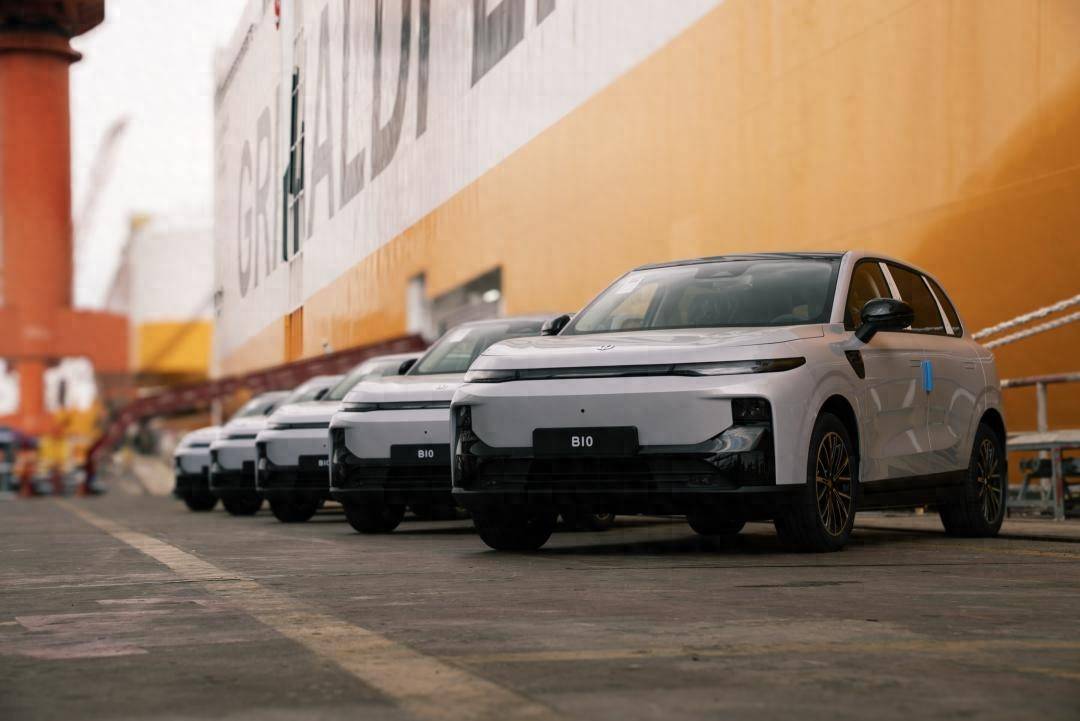
In May 2026, the two parties announced a partnership upgrade: the Leapmotor B10 model will enter production at Stellantis's Zaragoza factory in Spain Stellantis. The core advantage of this model lies in leveraging Stellantis's 850+ European sales and service outlets to achieve channel penetration in a very short time.
3.6 Comparison of Going-Global Strategies Among Five Automakers
| Dimension | BYD | Chery | SAIC MG | Geely | NIO | Leapmotor (Supplementary) |
|---|---|---|---|---|---|---|
| 2025 Overseas Sales | 1.046 million units | 1.344 million units | 300k+ units (Europe only) | 420k units | ~25k units (Europe) | 40k units (Europe) |
| Main Markets | Southeast Asia, Latin America, Europe, Oceania | Russia, Middle East, Latin America, ASEAN | Europe (UK, Italy, Spain, France, Germany) | Southeast Asia, Middle East, Latin America, Europe | Europe (Norway, Germany, Netherlands, Sweden, Denmark) | Europe, Latin America, Asia-Pacific, Middle East & Africa |
| Overseas Factories/Bases | 7 factories (~1 million units/year capacity) | 16 production bases (350k units/year capacity) | 4 manufacturing centers, 3,000+ dealers | Leveraging Volvo/Renault channels | 0 factories, 78 battery swap stations, 23 NIO Houses | Stellantis Spain factory (planned) |
| Strategy Model | Vertically integrated "supply chain going global" | Scale-first "multi-brand parallel approach" | Brand-first "deep cultivation in Europe" | Asset-light "multi-brand tiering" | Full-system premium "user going global" | Joint venture "piggyback going global" |
| Core Advantages | In-house battery R&D + self-owned fleet + full-category coverage | Export volume #1 + dual-brand rapid coverage | 11-year European sales champion + brand heritage assets | Volvo/Renault channels + three-brand tiering | NIO House + battery swap stations + BaaS user stickiness | Stellantis channels + localized production |
| Key Risks | EU tariff impact (>40% total rate), multi-country management complexity, QC reputation | Blurred brand positioning, destocking pressure from aggressive expansion, low profit margins | EU 45.3% tariff profit erosion, latecomer localization catch-up | Weak channel control, brand coordination costs | Battery swap station capex burden, small scale, profitability challenges | Limited brand autonomy, joint venture control dynamics |
3.7 Summary
The globalization paths of the five automakers reveal a gradient evolution from "product export" to "industry going global." The common trends are clear: localized production is replacing pure export as the mainstream choice, multi-brand strategies are becoming increasingly prevalent, and Europe's tariff barriers and regulatory thresholds represent a "stress test" that all automakers must face. The next phase of competition will shift from "who can enter" to "who can be profitable," from scale expansion to value creation — this is precisely the meaning behind this report's title, "From Scale to Value."
Related Posts